Hurricanes: A Floridian Past time
I remember when I was 5 years old, I had this book titled “1001 Facts About The Earth”. There was a page on meteorology, of which I would read and reread, where I first had learned about cumulus, stratus, and cirrus clouds–among other cloud types which kickstarted my love for meteorology, where I would spend as much time as I could glancing at the sky and trying to predict the weather for the next few days. I would then proceed to study weather maps and other hobby meteorology, especially regarding thunderstorms and lightning.
Living in Orlando, there was no shortage of severe weather, from our daily summer lightning storms to waiting for the Atlantic Ocean to score a strike with a hurricane upon Florida. I’m old enough to have remembered experiencing Charley and Katrina, among the other hurricanes that would be sent our way. Now we as Floridians do not fear these storms. In fact, it’s a huge part of our culture to enjoy the hurricanes, unless we live on the coastline or otherwise in flood prone areas or mobile homes. Before Publix was forced to stop making them, we’d order hurricane party cakes, or “hurricakes” as we so called them, and we’d enjoy a few days off work with our buds and a few beers, hunkering down. If it wasn’t rated a minimum of Category 4 or 5, we wouldn’t tend to worry, and say things such as “we needed the rain” or otherwise grumble about having to pick up the yard debris in the aftermath.
Juicing The Blender: Rising Sea Surface Temperatures Fueling Hurricane Growth
However, research says that hurricanes are three times stronger than they were at the start of the 1900s. Not only have the frequency of major storms (Category 3 or higher) increased, hurricanes are developing faster and moving slower, giving us less time to prepare, and leading to more destruction as the hurricanes stagnate over an area. Recently, the National Hurricane Center was able to extend their 5-Day Cone prediction to a 7-Day Cone prediction, allowing us a very necessary extra 2 days to prepare. Perhaps we here in Florida are quite prepared for the hurricanes–and quite enjoy them, as many of us have infrastructure designed to withstand the storms and insurance to protect from them. Not many people are this lucky–especially outside of Florida, so those two extra days can literally save lives.
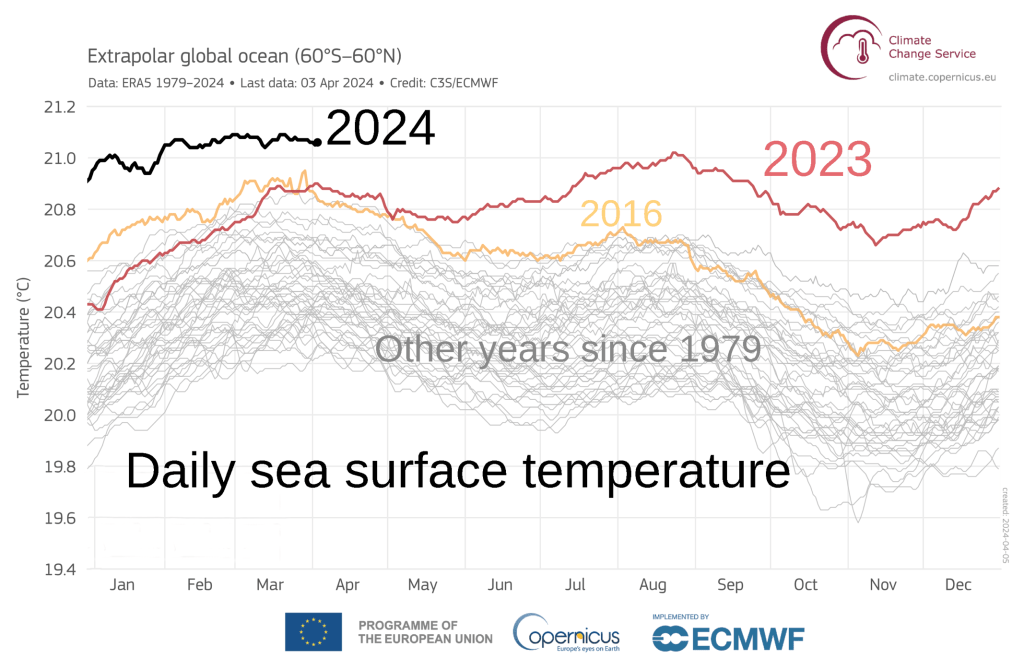
Those but the staunchest of ostriches are well aware that our climate is warming at an unprecedented rate, and that if we do not do something to mitigate our climate trajectory by 2050, it might be too late. Yet previously, these trends upward have been predictable, with a steady rise in sea surface (and otherwise global) temperatures. Despite trends in both El Niño and La Niña, which affect the strength of hurricanes in the Atlantic and Pacific basins, the recent trend in sea surface temperatures (SSTs) have been beyond anomalous. The SST is responsible for fueling the growth of hurricanes, as warmer oceans create the moisture and updrafts necessary to drive the growth of hurricanes in areas of low atmospheric shear and air pressure. The anomalous deviation first started to occur in early 2023, and proceeded to rise into 2024 and to date. The 2023 hurricane season occurred during a strong El Niño event, which suppressed the production of more powerful storms, despite the anomalous growth in SST.
Now while one may look at the data and tell themselves that storms do not appear to be getting much worse–it’s important to consider there is more to understanding and ranking hurricanes than the number of hurricanes per category per year. While the Atlantic hurricane season starts from June 1st and runs until November 30th, hurricanes are forming earlier in the year than ever before. While it isn’t uncommon for off-season hurricanes to occur, they’ve been occurring more consistently, with a streak of off-season hurricanes occurring between 2015 and 2021.
One of the most reliable metrics for truly evaluating a hurricane season is the Accumulated Cyclone Energy (ACE), which measures the sustained energy output of all storms across a given season. It has been predicted that the 2024 season will have an ACE nearly double that of the 1991-2020 average, with almost every other metric nearly double the average in prediction. It is predicted that there may be 25 hurricanes this year–and with 21 allotted names per year, we are likely to trend into using the backup name list–once so rare, Greek letters were used, but now so common that the process of naming post-list hurricanes may change. Between 1966 and 2022, all of the top 10 seasons have occurred after 1991, the peak being the notorious 2005 hurricane season with an ACE of 250, with 2024 predicted to have an ACE of 231. For comparison, the only year with a higher historical ACE was 2005, and one in 1939 of 259–although the quality of data collection in that era is questionable. Despite there being similar numbers of storms occurring over the years, one can very clearly see how this is a misleading metric of just how bad the hurricanes are getting (consider how there are more taller bars, a higher ACE, more recently than before, in that histogram). These emergent properties suggest an ominous trend towards a climate disaster.
Hurricane Beryl that recently affected parts of Middle America and the Caribbean is the earliest Category 5 on record, formerly held by Hurricane Emily in 2005 (the same year of the notorious Hurricane Katrina). What’s especially shocking about Beryl is how rapidly it intensified. The late June / early July SSTs were closer to where they are closer to the September average, until whence most major hurricanes don’t form. The lack of wind shear and other damaging conditions (fueled even more by the current La Niña trend) caused Beryl to rapidly intensify.

One does not need to be a climate scientist–or even climate enthusiast–to see just how much warmer the ocean has been, and to understand how this could fuel hurricane growth. It is worth noting that the 2005, 2017, and 2022 seasons that produced Katrina, Irma, and Ian were considered weak in terms of La Niña–whereas this season’s trend towards La Niña so early on have climate scientists concerned, especially with such a storm as Beryl forming so incredibly early in the season, with wind shears (which inhibit hurricane formation by ripping cloud formations to shreds via different wind directions or speeds at different altitudes) being decreased and SSTs as incredibly anomalously high as they are.
With some climate scientists calling for a new Category 6 rating, of storms with wind speeds over 309 km/h, the growing need of such a storm classification is shown in the existing storms that meet such a classification, with five such storms occurring between 1980 and 2021–all of which occurred during the last 9 years of the window. As the early Beryl shows what sort of storm is already possible this season, one cannot help but to worry what may come later this year–and if such a Category 6 rating will find its official establishment on the Enhanced Saffir-Simpson Hurricane Wind Scale later this year.
The current conditions in the Atlantic and Hurricane Beryl form an incredibly foreboding sign of what may come not just this hurricane season–but what may become a new normal for our climate as rising temperatures spiral out of control. Perhaps this is Mother Nature’s way of self-correcting, in an attempt to warn us about how She can take us out if we do not take care of Her, but one thing is for certain–hurricanes are getting deadlier and more frequent, and if we do not take heed and warning from what the trend has been, the SST charts becoming broken in its anomalous trends, and how terrible this 2024 hurricane season is forecasted to be, we may not be prepared for what may become the new normal–before it could potentially get worse.
Six Degrees Could Change The World
My favorite movie as a kid was The Day After Tomorrow. While an unrealistic depiction of what climate change could become–the potential for an irreversible global climate catastrophe that could collapse entire industries responsible for feeding us and keeping us safe is a fate we are rapidly heading towards, should we not pledge towards sustainability and working towards reversing the damage we have done to our planet. It is said that a six degree Celsius shift in global climate change is enough to turn our planet into a desert (or in the opposite direction–an iceball). When the aforementioned documentary–which many-a-student were shown in their Earth-Sciences class growing up–was released in 2008, the global temperature anomaly was 0.54 degrees Celsius. In 2023 it was 1.17 degrees Celsius. The terrifying part? 2022 was 0.89 degrees Celsius, and the highest it’s ever been before then was 1.01 degrees Celsius. With the rise in SSTs even more this year–it’s terrifying to think what this number may jump to by the end of this year.
It has been thought that we had until 2050 before we would hit the 2 degree Celsius point of no return, with the 1.5 degree Celsius estimate being hit between 2026 and 2042. Some estimates suggest we may hit the 1.5 degree Celsius mark by 2032, although with 2024’s temperature beating 2023 temperatures by an unbelievably anomalous margin–we may hit that mark sooner than we think. As much as we hope that we have until 2050 before we hit the 2 degree Celsius mark, the recent changes in SSTs suggests in perhaps what is the most terrifying climate graph on record–that we may have already passed some form of point of no return. It is absolutely imperative and should be our top priority to throttle this problem–which will be the destruction of us all if we do not do something about it–as soon as possible, as a climate disaster may not simply be something of the future–but something that has already been kickstarted and will rapidly and continually worsen over the next few years, not simply decades.
Sustainability: An Imperative, Not A Metric
With the 2024 election looming on the horizon, it is important to remember that our planet and its climate transcends politics, and affects us all, whether we agree with it or not. It doesn’t matter if you “believe” in gravity, because we are all falling out of a plane and rapidly accelerating towards a disaster. You can choose to ignore what is happening, despite the data, but all that will do is turn you into pavement chutney in the end, should you choose not to pull your parachute cord. Unfortunately this parachute requires all of us to pull that cord, or else we will all be pavement chutney. Climate change is an incredibly looming problem that has already crossed a pivotal tipping point, back in April of 2023, and we may face a horrific climate collapse sooner than we could’ve ever predicted.
It is not simply enough to use paper straws or walk/bike than ride a car–as individual people account for tremendously less of emissions, with 100 companies producing over 70% of all greenhouse gas emissions. This was a study done in 2017–and with the explosion of energy use in the data center and tax-evasion (money printing machine) industries, this number is likely significantly larger now than it was in 2017. It is part of a greater corporate and political agenda to push the responsibility of averting the climate disaster onto the lay populace, while major corporations continue to be three-fourths of the problem, doing little to nothing to lessen their contribution to the climate disaster we are careening towards at an accelerated speed.
While Big Tech claims they are attempting to meet sustainability standards–and I am sure (most of) Big Tech of all industries would not ignore the overwhelming data supporting the oncoming climate disaster–they face tremendous issues of their sustainability goals being unrealistic, prioritizing carbon neutrality as opposed to achieving broader climate sustainability than net-zero carbon metrics. With the growth of AI fueling data center energy demands to the point where data center companies feel pressured to return to non-renewables such as coal, data center sustainability should be a crucial priority for these companies that know very well the impact they have on the environment, and to prioritize protecting our planet before deciding to fuel hallucination and IP-theft engines in an era where an irreversible climate disaster is imminent within the next few years rather than decades.
Now I’m literally the type of Florida Man to go outside during a hurricane “because it’s fun” (for legal reasons, I do not recommend doing this yourself), and as someone that actively wishes for a hurricane to strike us, as they’re a thing of comfort for me and many other inland Floridians, I actively look forward to every single hurricane season as they come, excited to hunker down without power, getting my battery packs all charged up, and listening to the winds howl in the candle light as I talk to friends and play my old GameBoy games. It’s a form of enjoyment to me, and it’s a uniquely Floridian experience to truly enjoy hurricanes, rather than fear them. Yet this year is different. Back when Ian first struck, I had this twinge of a feeling that something was coming, very soon. Call it intuition, call it clairvoyance or gut–but something told me that 2024 and onwards would see some of the worst hurricanes on record. And so–the data trends do seem to be holding up to that gut feeling, and for the first time in the 23 years I have lived in Florida, this hurricane season terrifies me, and did long before Beryl formed.
The data does seem to suggest–as do many climate scientists–that 2024 may be the worst hurricane season on record, and so may every season henceforth. Beryl should send warning bells screaming at everyone’s doors, as with every other metric indicating the foreboding nature of this season, that a climate disaster is at our doorstep, and if we don’t do something about it soon, we will all perish, regardless of whether we “believe” in climate change or not. Data, science, and nature does not care if you “believe” in it, and it will take its actions regardless, and nature will self-correct and take out what is attempting to destroy it, like an immune system fighting a virus.
It is more critical than ever for us to prioritize fixing our climate, before Mother Nature fixes us. The steps we take today and tomorrow are steps we needed to take yesterday and the day before, before the Day After Tomorrow becomes today. It is imperative that climate regulations are enforced and those companies breaking such are met with punitive actions, if we want to save our planet and ourselves. Mother Nature will recover from how much we have abused Her–so has she from asteroid impacts and even gamma ray bursts, but not without mass extinctions that wiped out over 50% of the species on earth. But if we shall not right our wrongs towards Her, so she will see us as a virus and eliminate us through another mass extinction event.
We have one planet we must cherish and love as our home, and despite farces and false promises of colonizing Mars by megalomaniacs with a cult following, we will not get a second home any time soon. And even if so–we must protect our home for the lives of all the rest of its residents. For if we do not fix nature, nature will fix us, and it will be in every right of Mother Nature to take us out.
 Fractal's Thought Emporium